
The launch of Tydro, the native lending protocol on Ink, the L2 released by Kraken, exemplifies how Aave's infrastructure enables rapid, secure, and trusted deployments. Aave’s architecture also is uniquely positioned to scale from zero to billions of dollars in liquidity, with a better liquidity profile per asset. In this case study we’ll take a look at how Ink leverages Aave’s infrastructure and how Kraken built on top of it using Kraken Earn.
Background
Ink is an Ethereum Layer 2 (L2) blockchain built by Kraken on Optimism’s Superchain using the OP Stack. Designed to bridge Kraken's millions of users to DeFi, Ink launched its mainnet at the end of 2024.
The Ink Foundation prioritized lending as a foundational primitive, recognizing it as an essential primitive for ecosystem growth. A robust lending protocol serves as a concentrated liquidity source, powering trading, structured products, yield strategies, protocol-native settlement, and composable financial applications. To deploy this quickly, securely, and cost-effectively, the Foundation chose a white-label instance of Aave V3, branded as Tydro.
Tydro launched in October 2025 as Ink’s native liquidity layer, a decentralized, non-custodial lending and borrowing protocol tightly integrated with the Ink ecosystem. Tydro is specifically curated for Ink, and features INK token incentives, a focused asset set, and planned connectivity to Kraken’s exchange products.
Leveraging Aave's Infrastructure for Rapid, Secure Deployment
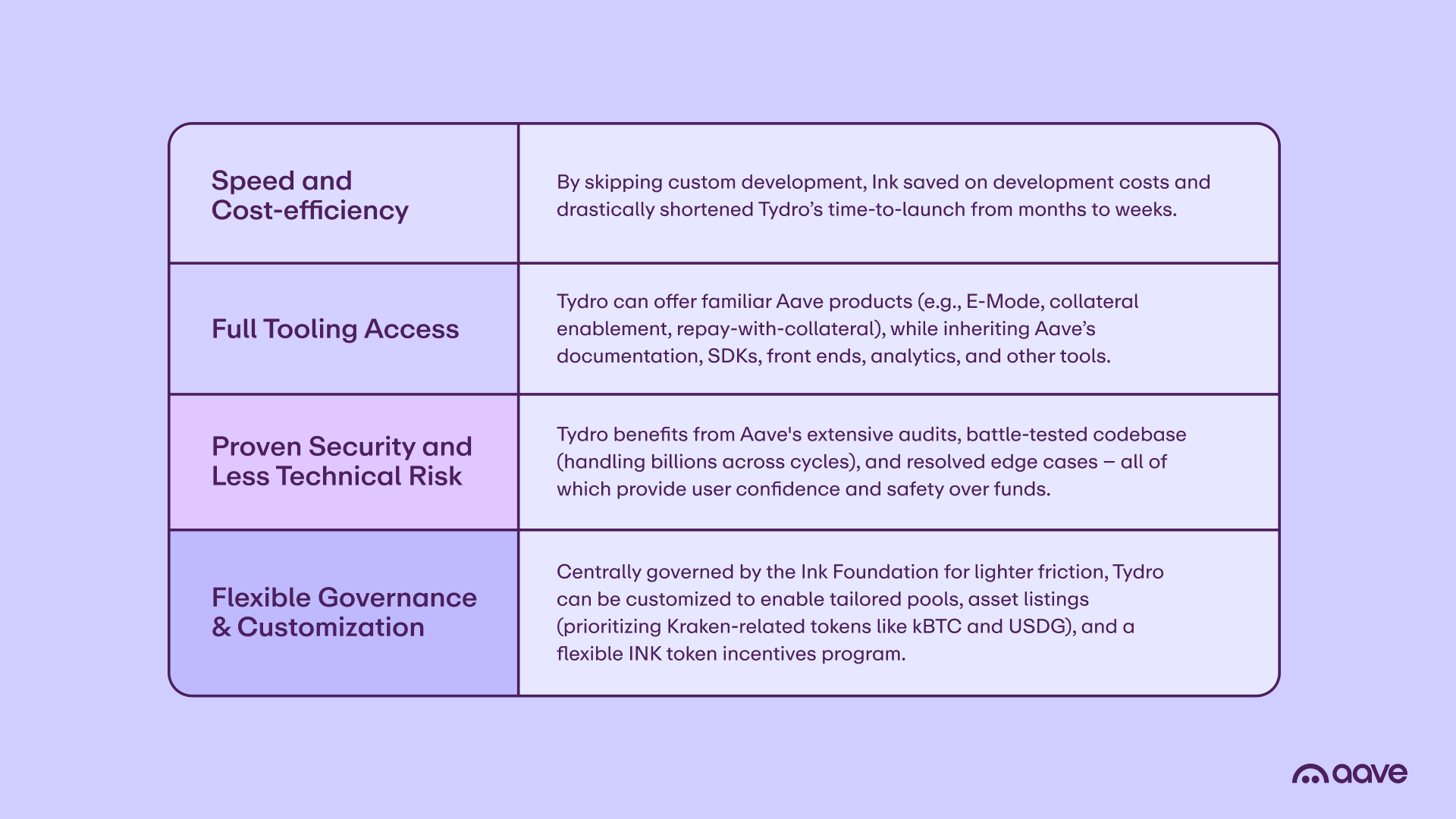
Rather than undertaking a ground-up implementation, Tydro achieved significant advantages by leveraging the Aave V3 codebase under a commercial agreement, with gains in efficiency, tooling, and security.
Advantages of Launching a Custom Lending Protocol, Powered by Aave
To support its launch, Aave’s risk managers have assisted with maintenance, risk management, and initial optimizations.
This approach created an immediate funnel for capital into Ink, with network activity surging post-Tydro launch.
Tydro Market Stats and Impact
Within its first four months, Tydro has shown strong growth and capital retention amid market volatility, serving as the flagship DeFi protocol for Kraken’s L2. At its peak, Tydro accumulated $600 million in total deposits with $350 million in TVL, comprising the vast majority of Ink’s total TVL.
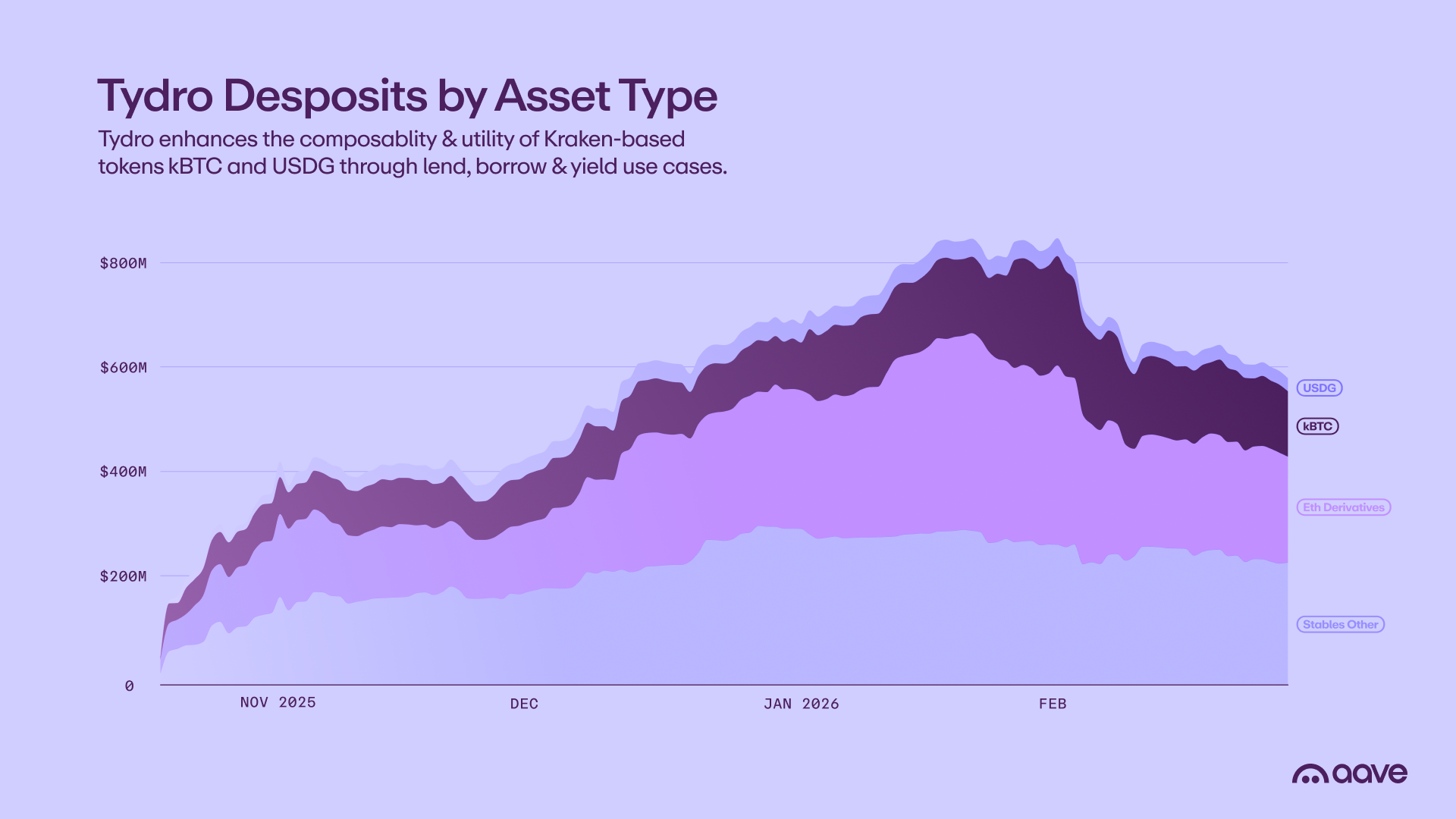
Tydro's curated markets focus on high-utility assets aligned with Kraken's ecosystem including kBTC (Kraken Wrapped Bitcoin) and USDG (consortium-backed stablecoin involving Kraken). By prioritizing these, Tydro enhances Ink’s interoperability while fostering deeper ecosystem ties for Kraken-based tokens. Tydro has also gradually expanded into other categories including Ethena-related assets and staked ETH derivatives to enable strategies like leveraged staking or yield optimization with stablecoins.
Larger Impact: Entrenching Kraken Users
According to Ink, Tydro will “integrate into Kraken products, giving users seamless access to DeFi within the Kraken platform.” As Ink’s native liquidity layer, Tydro can serve as a foundation for Kraken structured products, protocol-native settlement, capital efficient trading, and composable financial apps.
Kraken’s vertical integration across the blockchain and app layer helps to entrench the exchange’s users by introducing onchain experiences to potentially first-time participants. Users can engage with Tydro and other Ink applications directly through the Kraken interface. This exemplifies a larger theme of Embedded DeFi experiences powered by Aave, where CeFi platforms embed DeFi primitives directly into their apps without having users manage complexities of wallets or bridges, lowering barriers and driving adoption.
The first major Tydro-based product offering came in January 2026 with the announcement of Kraken DeFi Earn, a product for users to earn yield on USDC holdings using Tydro and Aave on the back-end. Kraken users can select from three different vault options, each of which is administered by Veda. The product has seen strong early traction, recently surpassing $200M in onchain deposits.
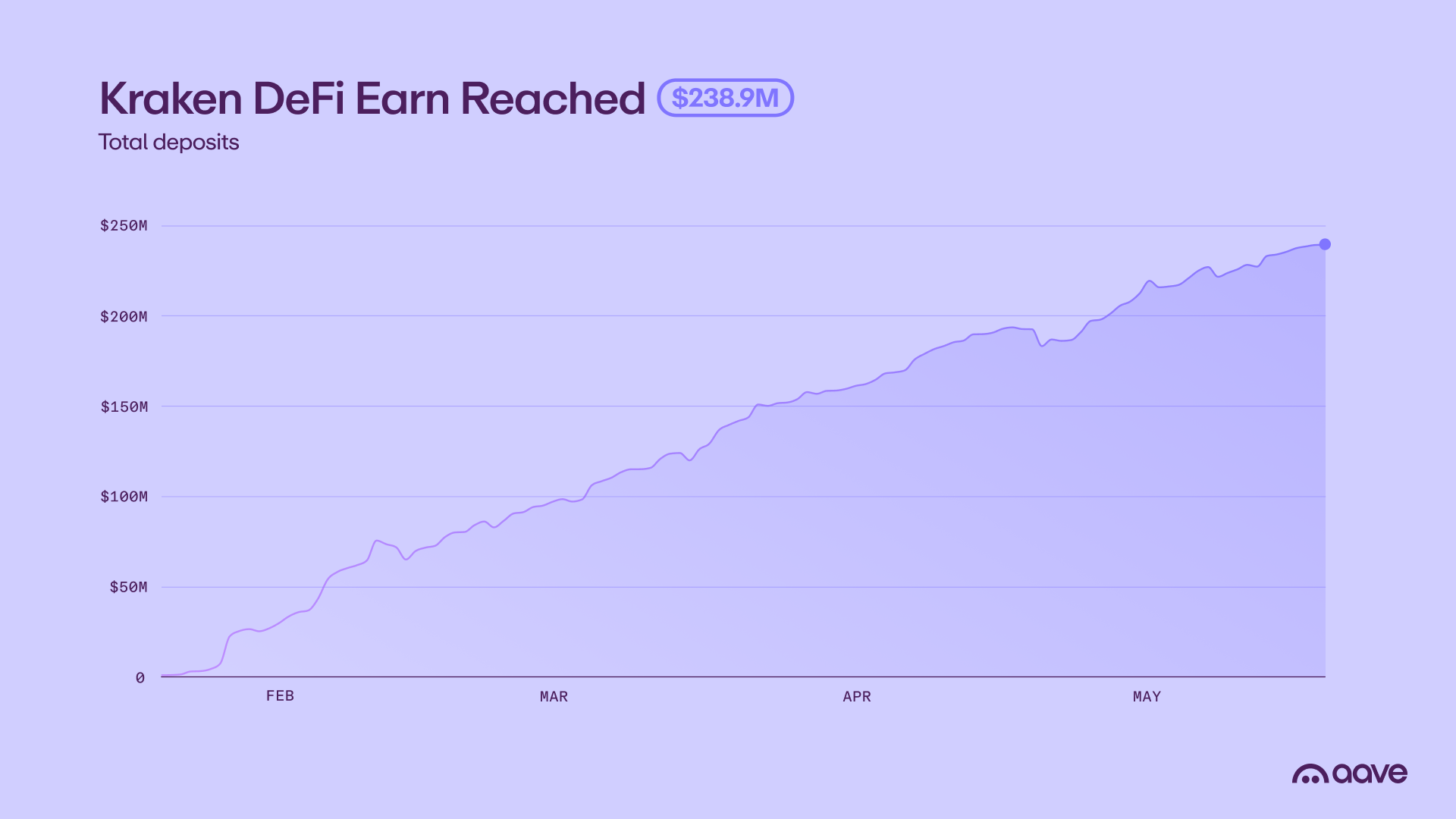
Source: https://dune.com/seoul/kraken-defi-earn
For Aave, this partnership scales the protocol by channeling CeFi liquidity into its markets, reinforcing Aave's role in 'CeDeFi' or hybrid finance. Aave can also power other embedded DeFi products including other stablecoin yield strategies, crypto-backed loans, or enhanced staking yields on crypto assets. For Kraken, this potentially could involve Kraken-related tokens for products like kBTC-backed loans or USDG-based stablecoin yield strategies.
Conclusion
Tydro's deployment on Ink exemplifies Aave's value in enabling secure, rapid DeFi launches for emerging ecosystems. From bootstrapping nearly $1 billion in deposits to powering embedded experiences like Kraken DeFi Earn, this case study shows Aave can be integrated across many user touchpoints, whether directly onchain or through embedded solutions, to drive adoption and innovation.
This also serves as a strong institutional endorsement of Aave. As embedded DeFi grows, Aave remains at the forefront, powering lend/borrow products for CeFi and fintech apps while helping them entrench their users deeper into their ecosystems. For those interested in building on proven infrastructure that doesn’t compromise safety or flexibility, just use Aave. Learn more about building on Aave’s proven infrastructure here.