
Across DeFi, a portion of deposited capital sits idle at any given time, earning little-to-nothing for users. Having some idle market liquidity serves a purpose, since protocols like Aave need a buffer to support instant withdrawals and maintain reliability. But every dollar sitting unused is a dollar that could be generating yield.
Aave V4's Reinvestment Module addresses this directly by automatically deploying unused protocol liquidity into governance approved, low-risk yield strategies, such as short-term Treasuries, to increase returns for lenders and grow revenue for the DAO. Because V4 connects idle reserves to off-chain yield rates, depositors can earn more than they would in comparable traditional instruments.
Inefficiencies of Idle Liquidity
Aave maintains a large portion of liquidity available for borrowing. Currently, out of ~$20 billion in total stablecoin deposits as of March 2026, $6 billion remains available for borrowing. This implies roughly 30% of the protocol’s stablecoin deposits on the protocol are sitting idle. While this has its benefits, it leaves room to explore ways to further improve capital efficiency on the protocol layer.
How V4's Reinvestment Module Works
The Reinvestment Module is one component of V4's unified liquidity design. In V4, a Liquidity Hub holds all supplied assets and serves multiple Spokes, which are individual lending markets with their own risk configurations and borrowing logic. Multiple Spokes can serve different use cases, such as institutional borrowing and specialized collateral types, while drawing from the same underlying liquidity.
The Reinvestment Module is an optional feature for managing idle liquidity and deploying it into yield strategies. It is opt-in and works with any strategy type approved by governance. Risk providers, for example, can configure which strategies are active for each asset. Eligible strategies are intended to be conservative such as stablecoin liquidity provision, money market instruments, delta-neutral basis trades, and wrapped token products that remain liquid and redeemable on short notice.
Based on these configurations, the Reinvestment Module sweeps excess capital into pre-approved low-risk yield strategies. When borrowing demand rises and utilization rates increase, the module automatically rebalances to replenish liquidity for additional borrows or withdrawals.
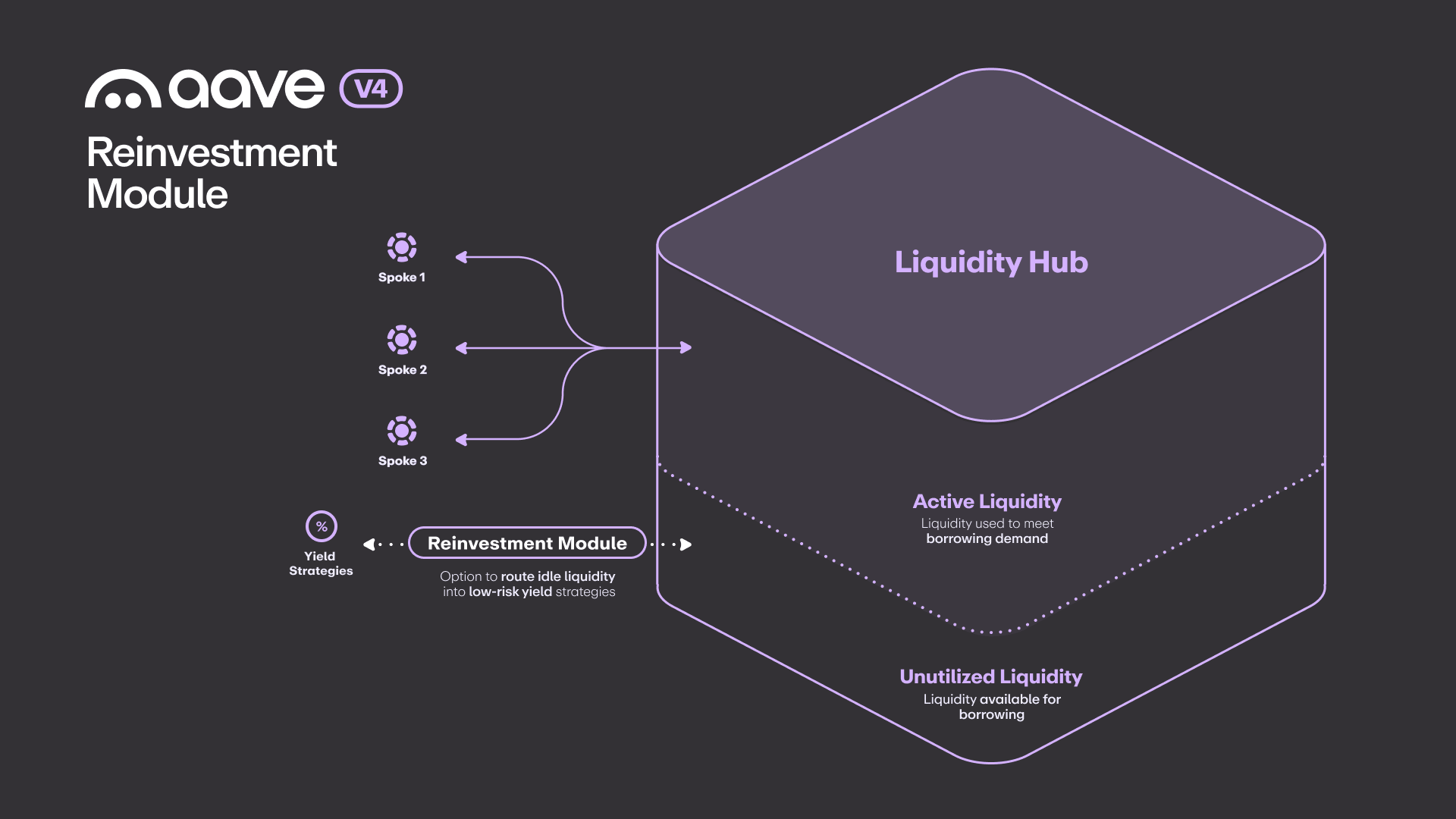
A reinvestmentModule address is configured individually for each hub asset, meaning USDC, USDT, ETH, and other markets can have entirely different strategies, limits, and activation states.
Note: Using the Reinvestment Module is not a requirement by the protocol. Aave governance and risk providers must evaluate strategies and actively decide to implement those strategies on a per Hub basis.
Deposit APY Impact
The Reinvestment Module automatically boosts yields on supplied assets by deploying excess idle liquidity into low-risk yield strategies, without any lock-up periods or withdrawal restrictions for depositors.
As borrowing demand varies, average stablecoin supply APYs on Aave have at times fallen below prevailing risk-free rates like SOFR. The ability to reinvest excess liquidity during these periods would help to establish a stronger floor for stablecoin yields and improve overall returns for depositors.
Based on 2025 historical data and simulations for major stablecoin markets (e.g., USDT, where idle liquidity averaged $1.2 billion), fully reinvesting excess liquidity at SOFR-equivalent rates could have increased the average stablecoin deposit APY from 4.00% to 4.93%. That’s roughly a 25% relative increase in yields for Aave depositors.
In practice, reinvestment would be partial and dynamically calibrated to each asset's risk profile, utilization patterns, and liquidity latency considerations. Conservative deployments, combined with dynamic interest rate model adjustments to protect solvency during withdrawal shocks, still deliver meaningful APY enhancements.
Outlook
Aave V4's Reinvestment module puts idle protocol capital to work. By deploying idle reserves into approved yield strategies, it generates yield across every market drawing from the Hub without requiring separate configuration for each. Capital on Aave earns more without depositors having to do anything, increasing what suppliers earn and what accrues to the DAO.
The module also makes Aave more useful to institutions and protocol integrators by increasing yields and adding strategy flexibility. New strategy types can be added through governance without requiring protocol upgrades, keeping the module current as market conditions change.
For a deeper look at the technical design and concept applications, see LlamaRisk's Reinvestment Module post and institutional and legal analysis, or check out TokenLogic's Hubs & Spokes article.