

Aave Horizon is a lending market on Ethereum that allows qualified investors to borrow stablecoins against tokenized securities or tokenized real-world assets (aka RWAs). It provides instant, 24/7 liquidity while respecting issuer compliance requirements. Since its launch in August 2025, Aave Horizon has grown to over $440 million in deposits, making it the largest and fastest-growing real-world asset market onchain.
The Problem with RWAs in DeFi
Most DeFi protocols were designed around permissionless assets like ETH. Tokenized real-world assets (RWAs) are different; they require specific investor qualifications and compliance oversight. Issuers control access through onboarding and verification, and transfers are managed with allowlists so that only approved wallets can hold or trade the asset.
Historically, protocols have tried to force these assets into existing architectures by wrapping them or creating synthetic versions. This approach cuts off composability and limits what can be built using RWAs.
Aave Horizon takes the opposite approach and redesigned the protocol to support permissioned assets natively. The base RWA itself is used as collateral, maintaining full exposure without introducing additional smart contract layers that could increase risk.
How Aave Horizon Works
Aave Horizon uses Aave's unified reserve architecture. Every stablecoin supplied contributes to a single shared pool accessible to all eligible borrowers, regardless of their collateral type. This is different from isolated pool designs, where each real-world asset needs its own separate stablecoin pair.
Isolated pools force every new asset to bootstrap liquidity from zero, which results in thin markets, high rate volatility, and slow growth. With shared liquidity, a new asset added to Aave Horizon immediately taps into the full depth of the existing stablecoin pool. Rates stay stable even during high utilization or leveraged looping.
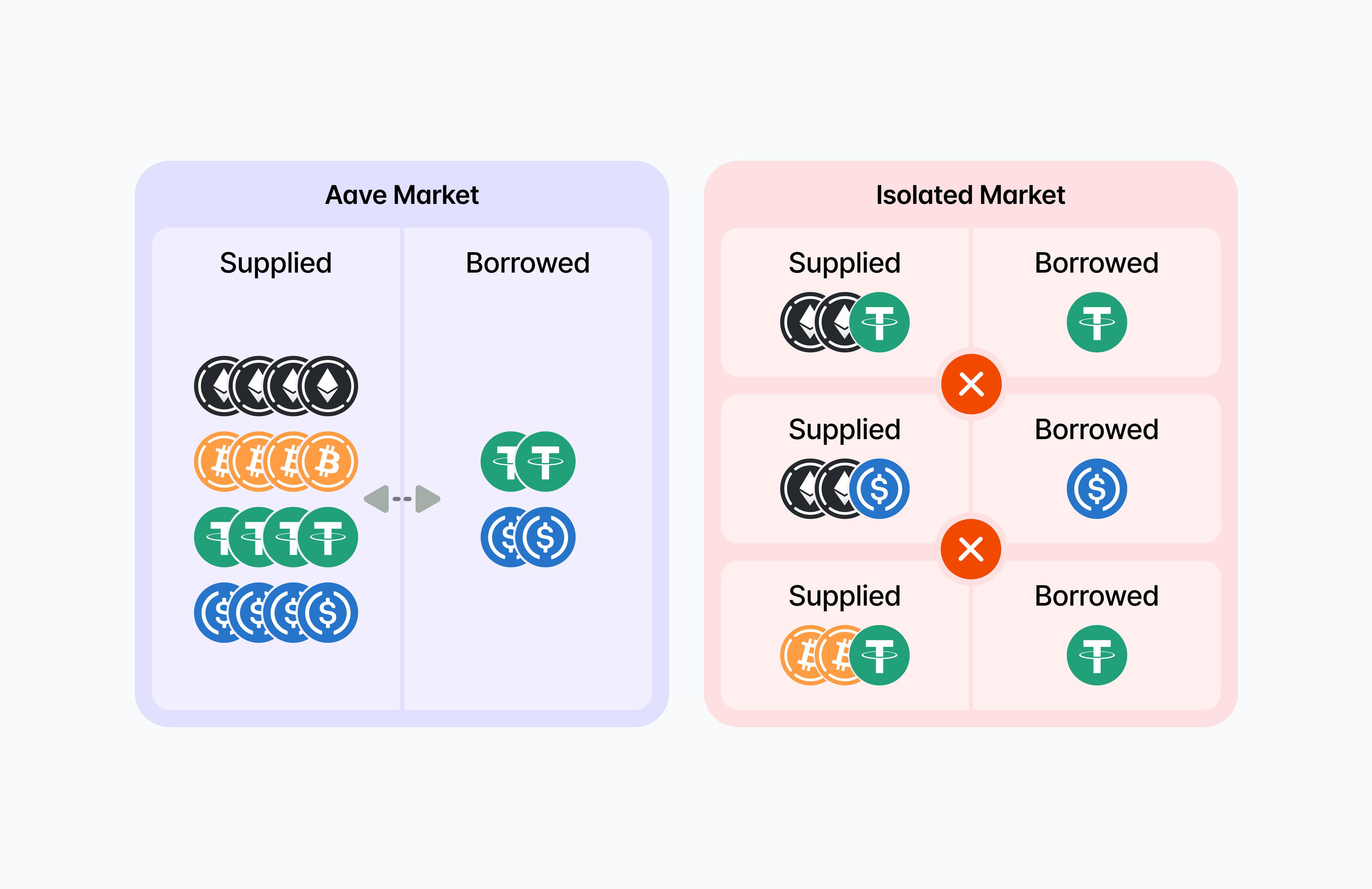
Because the market supports native assets and pools liquidity across them, it functions as infrastructure that developers can build on. Anyone can integrate with the protocol programmatically, so users are not limited to the Aave Horizon UI.
Aave Horizon Earn is one example of what integrators can build on top of Horizon to offer users stablecoin yield from KYC'd institutional borrowers. Using the same stack as Aave Earn, it provides API and ERC-4626 vaults that wallets, exchanges, custodians, and treasury platforms can embed as a simple deposit-and-earn product. Each vault supplies the user's stablecoins into Aave Horizon and manages everything in the background, so users just deposit, receive vault shares, and earn yield without interacting with the protocol directly.
More broadly, integrations can support both borrowing and yield products. Partners can let qualified users borrow stablecoins against RWAs, including tokenized stocks and ETFs as they are added, directly against assets held on their platform.
Compliance and Risk Management
While the liquidity is shared, compliance remains specific to each asset. Issuers onboard investors, manage allowlists, and set eligibility requirements. After an investor completes the issuer's subscription process, including KYC, the issuer allowlists their wallet to hold the RWA.
That said, the protocol itself remains permissionless to use; any wallet holding an approved token can supply it as collateral to stablecoins under the defined parameters. Issuers control who can hold the token, and the protocol enforces those rules automatically. Additionally, any users can supply stablecoins to earn yield, which attracts deep liquidity for the market.
The system separates duties across specialized layers. Issuers handle asset-level compliance. LlamaRisk is Horizon's independent risk service provider; they run diligence on each RWA, define the risk framework, and recommend and maintain parameters like loan-to-value (LTV), liquidation threshold, and supply and borrow caps. Chainlink provides the onchain pricing and validation layer via LlamaGuard Net Asset Value (NAV). Chainlink operators deliver verified NAV data onchain and support automated safeguards when feeds are stale or out of bounds. Aave Horizon executes lending through deterministic smart contracts. This separation means institutions can access programmable liquidity with the same safeguards they expect from traditional finance.
The Foundation for Institutional DeFi
Onchain real-world assets have grown past $25 billion, and there is a need for safe, compliant, and scalable infrastructure to support them.
For issuers, asset managers, and stablecoin providers, Aave Horizon offers programmable liquidity with institutional-grade safeguards. The architecture does not force compromises between compliance and composability. As more tokenized assets come onchain, Aave Horizon sets the standard for how they should work in DeFi.